

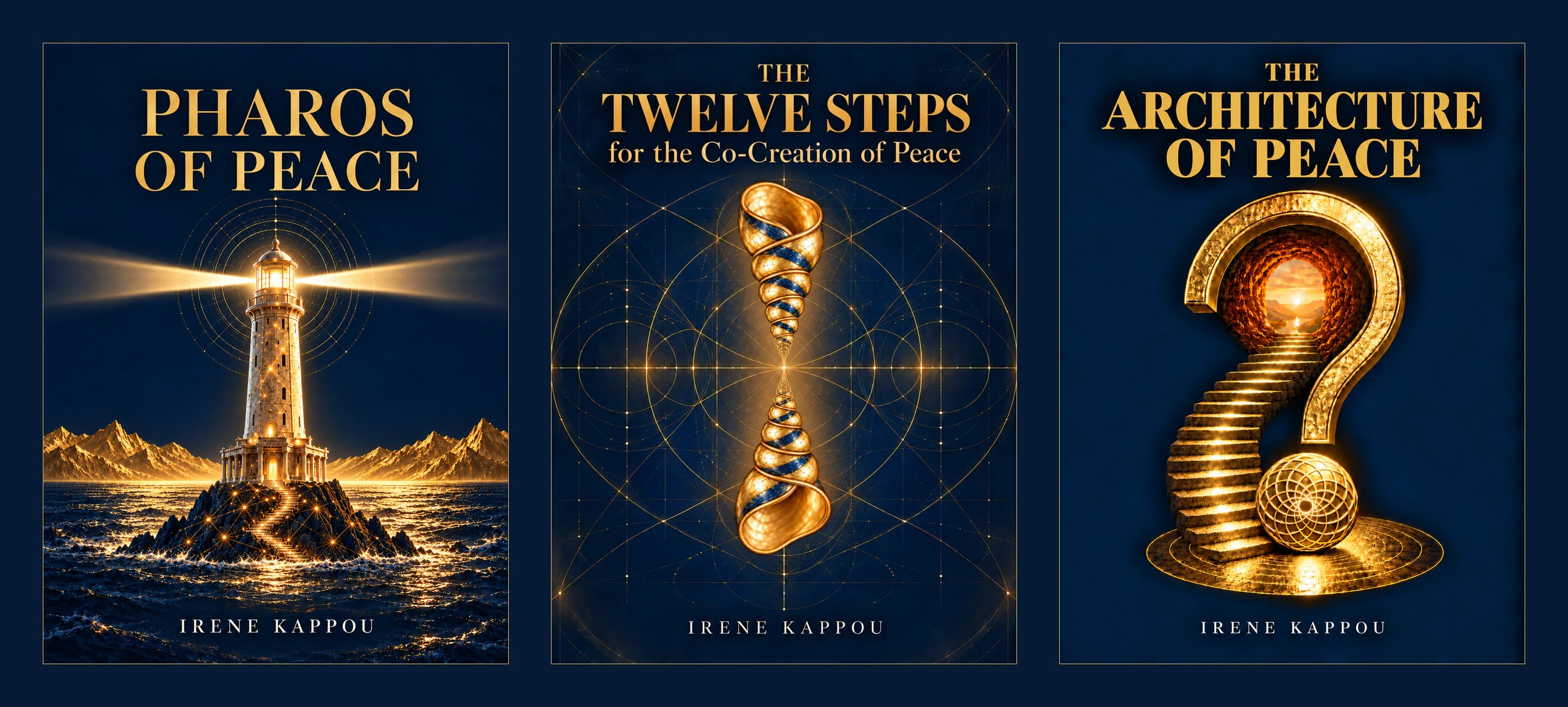
The Trilogy of Peace: Pharos of Peace · The Twelve Steps for the Co-Creation of Peace · The Architecture of Peace.
Three books by ELESTIA’s founder, Irene Kappou. Pharos of Peace develops the philosophical inquiry. The Twelve Steps for the Co-Creation of Peace proposes a developmental method. The Architecture of Peace connects these foundations with educational programs, research and institutional cooperation. Together, they form the written foundation of ELESTIA’s work.
The first two manuscripts are completed · the third is nearing completionIPharos of Peace
The Philosophical Foundation
Completed manuscript · in preparation for external review and publication
The book takes its name from the lighthouse: something that offers orientation without forcing another person’s course, that guides without governing. Its opening question is simple but demanding: is peace something humanity waits for, or something it must learn to cultivate?
The inquiry moves in four movements — Discovering Reality, Discovering the Human Being, Discovering Civilization, Becoming the Lighthouse. It begins with peace, order and the natural world; turns to the human being — how we perceive, how we know ourselves, how we change; examines the relationships, education, cultures and institutions that shape human development; and asks what an architecture for cultivating peace might require. It then returns to the person, and asks what understanding demands from the one who has gained it.
Throughout, the book distinguishes documented knowledge from philosophical interpretation, symbolic material and its own original synthesis. Its contribution is a sustained argument connecting self-knowledge, ethical responsibility, the Absolute Good and the cultural and institutional conditions of peace.
IIThe Twelve Steps for the Co-Creation of Peace
The Developmental Method
White Paper completed 2025 · full manuscript completed
How can self-examination grow into responsibility for the world we share? The Twelve Steps gives this movement a defined structure, with three steps in each of four fields of responsibility:
- The IndividualSelf-Examination · Acceptance · Non-Oscillation
- The GenerationObservation · Connection · Elevation
- The NationSelf-Determination · Recognition · Goal Setting
- HumanityRe-Examination · Documentation · Implementation
The steps invite repeated examination. Acceptance does not require approval of injustice; steadiness does not prevent reconsideration; responsibility grows through attention to consequences and the willingness to learn. Educational applications draw on selected principles according to their audience: the children’s Peace Hub pilot, for example, is a distinct program rather than an implementation of the whole framework.
IIIThe Architecture of Peace
The Framework for Application
Manuscript nearing completion · intended to be offered free as a PDF when ready
What structures can help knowledge, cooperation and education sustain one another? The third book examines how an initiative moves from purpose to implementation: identifying an audience, defining responsibilities, bringing together expertise, securing resources and establishing ways to review what happens. It sets out the Threefold Model and the institutional architecture — the Peace Network, the Peace Hubs, and the longer-term Forum, Think Tank and Academy — while distinguishing current work from proposed development.
How the Books Work Together
| Book | Central question | Contribution |
|---|---|---|
| Pharos of Peace | What is peace, and what makes it possible? | Philosophical foundation |
| The Twelve Steps | How does understanding become wider responsibility? | Developmental method |
| The Architecture of Peace | How can this work take sustained practical form? | Framework for application |
Readers may begin with the question closest to their interests. The sequence from foundation to method to application offers a path through the whole.